Showing posts with label heart health. Show all posts

Wednesday, February 13, 2013

Snack Attack: Spicy Baked Chickpeas!

Image via flickr.com
In honor of full-disclosure, I should tell you a few things...

1) No matter how health-conscious I become, I will never say 'no' to a good snack.
2) If I ever have the pleasure of being invited to your home, I WILL (no doubt about it) sneak a peek inside your pantry to assess your 'snack factor'. 
3) If your snacks are savory, kiss them goodbye.
4) If they are sweet, breathe a sigh of relief. You're in the clear.
5) I consider a person's 'snack factor' very important when choosing a mate... and you should too!

It's pretty clear I love to snack. I can barely get through the hugs and hello's when I go home to see my parents without making a beeline for the pantry to see what's up. It's shameful but true (right, mom?). So since February is all about the   L-O-V-E and snacks are my one true culinary love, why not spend the month featuring my favorite healthy treats?

Last week, I went back for more of Ella Nemcova's 'Cleanse Cooking Class' at Freshmade NYC. We started things off with her recipe for Spicy Baked Chickpeas. This snack is reminiscent of munching on a handful of your favorite nuts, without the high fat content! Chickpeas (or garbanzo beans) are a great source of protein. Just 1 cup provides you with 30% of your daily requirement! In addition to protein, chickpeas are packed with fiber, antioxidants, potassium (for heart and kidney health) and thiamin (for brain health and mood regulation). Could this snack be any more impressive?!?

The onset of Blizzard Nemo last weekend left me with all the time in the world to try making them on my own. Did I forget to mention that they're SUPER EASY too?

Here's the play-by-play...

Preheat the oven to 400 degrees and arrange a rack in the middle of the oven. You'll need 2 cans of chickpeas (again, chickpeas, garbanzo beans... same thing) and extra-virgin olive oil (try to use the good stuff)!
Drain and rinse your chickpeas well. Then pat them dry with a paper towel or clean dishrag and throw them in a large mixing bowl.
Add 2 Tbs. extra-virgin olive oil.
Sprinkle with 1 tsp. ground cumin, 1 tsp. chili powder, 1/2 tsp. cayenne pepper and 1/2 tsp. sea salt. Mix well to evenly coat.
Place the chickpeas in an even layer on an ungreased baking sheet...
...and bake 30-40 minutes until crisp. Just watch carefully at the end so they don't burn!
Look at that beautiful snack! This basic recipe has endless possibilities! Next time I'm making a sweet version!
Snack away, my friends! There's no shame in THIS snack!

Wednesday, December 5, 2012

Amaranth: Spicing Up Your Breakfast The Aztec Way!

Image courtesy of southernexposure.com
You may recall my breakfast confession from a few months ago. You remember, right? How I used to eat anything BUT breakfast food for breakfast? Seriously, when I was in elementary school a bowl of spaghetti or some leftover meatloaf would do just fine in my book. Gross, I know.

Though I've graduated from leftover meatloaf, I still feel like something's missing in the breakfast arena. You've got your eggs, your granola, your toast... maybe even your healthy smoothie if you're feeling spunky... but all these choices still leave me feeling like something's missing. This past weekend I decided it was high time to try something new... something old school yet little known... a little something I like to call amaranth.

Excited? Ok, good. Here we go! Let's talk about amaranth.

Image courtesy of yumuniverse.com
Amaranth is usually grouped into the 'grain' category, although it's not really a grain. It's actually the seed of a flowering herb. Amaranth has been around for a long, long time. It was a dietary staple of the Aztecs. At one point in time, it represented almost 80% of their daily caloric consumption! To this day, amaranth is generally grown in Mexico, Peru and Guatamala, although many Asian countries now grow it as well. You can find it in your local health food store or natural grocery store (think 'Whole Foods')!

And great news for a few of my sensitive friends out there, amaranth is GLUTEN-FREE! Happy stomachs everywhere!

(Insert happy stomach dance here)


Amaranth is a very concentrated source of nutrition. Let me explain why amaranth is so great...

HIGH IN PROTEIN - Just 1 cup of amaranth equals about 28 grams of protein. If you remember from my previous posts, the average person needs approximately 50 grams daily. That's almost half your daily requirement! What's even better is that you're getting the plant-based protein without the fat! Perfect combo! 

CHOCK FULL OF CALCIUM - I don't want to burst your dairy bubble, but amaranth is a better source of calcium than milk. Because amaranth also contains magnesium and silicon, which aid in calcium absorption, you are better able to use the calcium in amaranth.

GLUTEN-FREE GOODNESS - I know I said it before, but I'll say it again... if you're gluten-free, amaranth is a fantastic 'grain' source because it contains more iron and fiber than other GF grains.

HEART HEALTH - Studies have shown that amaranth consumption lowers cholesterol and triglycerides in the blood, keeping your heart healthy and strong.

This weekend I wanted to experiment with amaranth. As many of you know, I'm in the midst of becoming a Certified Health Coach through the Institute for Integrative Nutrition in New York City. As part of this week's material, we were encouraged to try cooking with something we'd never used before. That's where amaranth comes in. 

Nothing like a warm amaranth porridge to get the day started right.

For 2 servings, soak 1 cup amaranth in a bowl of water overnight for 8-12 hours (amaranth is most nutritious and digestible if it's soaked prior to cooking).
When you're ready to cook the next morning, bring 3 cups of fresh water to a boil. Meanwhile, pour the amaranth through a strainer (just make sure your strainer's holes are tiny enough to capture the amaranth, which is fairly small, even after soaking). Discard the leftover water and pour the amaranth into the boiling water. Add 1/2 tsp. of sea salt.
Reduce to a low simmer for 30 minutes and cover, stirring periodically. At the 20 minute mark, grab your healthy ingredients
and get busy doctoring your porridge. 
Throw in 1/2 cup of dried goji berries (a fantastic superfood).
Stir in 1/4 cup of milk (or a milk substitute like hemp milk in this case)... if it's not creamy enough for your liking,
don't be afraid to add more.
Add 2 Tbs. of honey...
Add 1/2 cup of currants, raisins or cranberries, whichever you prefer.
Top with raw pine nuts or any other nut that you're digging on (pecans, walnuts or
slivered almonds would work well too).
Grab a cup of hot tea and you've got yourself one impressive, immune-building breakfast!

Wednesday, November 7, 2012

Asparagus: A Minor Love Affair

Image courtesy of worldcommunitycookbook.org
If I could eat asparagus every day of my life, I would. I mean, for starters, it's freakin' cute. It comes in a compact bunch... it's my favorite color... it has such lovely details on the end of its spears... it tastes fantastic. What's not to like? Now I admit, I sound nuts, but just ask Adam and he will confirm that I am preaching the truth here! I make a bee-line for asparagus just about every time we walk into the market. Long live asparagus! And yes, I'll take seconds!

Not only is asparagus tasty and good-lookin', but I'm happy to tell you that it's fantastic for your insides! Here's why...

CANCER FIGHTING - Asparagus contains many antioxidants, among them glutathione, which has been referred to as 'the mother of all antioxidants'. This antioxidant actually attracts toxins and free radicals, then removes them from the body. The anti-inflammatory compounds in asparagus also help to prevent cancer.

HEART HELPING - The fiber and B vitamins (among them, folate) in asparagus can help lower the risk of high blood pressure, heart disease and stroke.

FLUID BALANCING - The high potassium content in asparagus helps to maintain the fluid balance inside the cells and tissues. Potassium is also essential in maintaining the activities of the nervous and cardiovascular systems.

DIGESTION SUPPORTING - The nutrient inulin (not to be confused with insulin) in asparagus passes undigested through the intestinal tract on its way to the large intestine, where it feeds the friendly bacteria that helps in nutrient absorption.

CELL GROWING - Just 1 cup of asparagus provides approximately 70% of your daily value of vitamin K, which is essential in cell growth, bone mineralization and blood clotting.

Now asparagus can be cooked in many different ways, but I'd like to share my favorite way with you now...

Preheat the oven to 450 degrees. After washing the asparagus well, cut off the hard ends and then slice the spears in half.
Grab your army of spices. I suggest sea salt (or regular salt), pepper and garlic salt or garlic powder.
On a grill pan (or regular saute pan), heat 1-2 Tbs. of olive oil on medium-high heat, add the asparagus and lightly season with your army of spices (you can always add more later once you taste it).


Press down on the asparagus as it cooks so it starts to get the 'grilled effect'. After it starts to soften and becomes a deeper shade of green (approximately 5 minutes), remove from the heat and put the whole grill pan in the oven (ONLY IF your pan is oven-safe). If not, just lightly spray a baking pan with non-stick spray and evenly space the asparagus on the pan.
Roast the asparagus on 450 degrees until it starts to shrivel (approx. 5-10 minutes). It will look like the picture above.
Serve it up as a side. It goes great with fish and it's SOOOO easy!

Here are a few other recipes to get your wheels turning...

ROASTED ASPARAGUS AND CHERRY TACOS
Sometimes the oddest combinations end up surprising you! She raves about this one!
Image courtesy of thekitchn.com


SHAVED ASPARAGUS PIZZA
Image courtesy of smittenkitchen.com


Thursday, October 11, 2012

The Health Benefits of Wine: I Can Toast to That!

Image courtesy of mylifescoop.com
I (heart) wine. I love it so much that I make it a priority to surround myself with people who share my sentiments. I learned to appreciate a good red from my friend Claire, who knows her way around a bottle. Then there's my friend Marissa, who I'm convinced just moved to San Francisco to be closer to Napa Valley. While I don't live anywhere near Napa (or France, where I'd really like to be for that matter), I still appreciate a good wine when I drink one, and today I'd like to share some really fabulous news with you!

Image courtesy of goodfoodworld.com
You may know this already, but wine can be good for you! -  really, ALL alcohol can be good for you. Now before you buy a case, call all your friends and dust off the ol' beer pong table, let me touch on why it's good for you, while also explaining the one disclaimer that might put a damper on your impending house party. Let's look at our next guideline from Michael Pollan's book Food Rules...

HAVE A GLASS OF WINE WITH DINNER

Now this sounds like a rule that I can get behind. I like wine. I eat dinner. Done and done! Michael Pollan goes on to explain...

"There is now considerable scientific evidence for the health benefits of alcohol to go with a few centuries of traditional belief and anecdotal evidence. Mindful of the social and health effects of alcoholism, public health authorities are loath to recommend drinking, but the fact is that people who drink moderately and regularly live longer and suffer considerably less heart disease                 than teetotalers."

Studies have shown that wine can be beneficial when you drink it in moderation. Moderation is a funny word because it's obviously different to different people. Moderation for you might mean two glasses a night, while moderation for the average college student might mean ten. The term moderate refers to the suggested 2 glasses per day for men and 1 glass per day for women, but the good news is: you can indulge moderately every single day if you feel so inclined!

Image courtesy of freedigitalphotos.net
Alcohol (of all kinds) raises your good, or HDL, cholesterol and helps to thin out your blood, thereby preventing build-up in your arterial walls. Then there's the phytochemicals in wine, which act as antioxidants and prevent the proliferation of cancer-causing free radicals in the body. Red wine is clearly the leader of the pack when it comes to health benefits, especially red wine from cooler climates. Red wine contains more of the phytochemical resveratrol. When making red wine specifically, winemakers allow the skin of the grape to stay on longer. The longer the skin is on, the more resveratrol there is in the end product. Resveratrol  works its magic by preventing blood clots and plaque formation in arteries, leaving you with a healthy heart. Malbec is a great example of a wine with high resveratrol content because the grapes used to make it have very thick skin. Other good choices are Cabernet Sauvignon and Pinot Noir.

Consuming wine during a meal seems to have its perks - other than avoiding that lightheaded, tipsy feeling you get when you drink on an empty stomach. When you drink during a meal, the compounds in wine help to  prevent the adverse effects of fatty foods during the digestion process. The two negative byproducts of fat digestion (malondialdehyde and hydroperoxide) - which are toxic to cells - are significantly reduced when wine is involved.

So the next time you're sitting down to dinner, don't feel guilty about pouring yourself a glass or two. When you drink in moderation, you can enjoy the life-saving perks!

Wednesday, October 10, 2012

Hump Day Humor: Laughter is the Best Medicine

Image courtesy of ipbrief.net
Sometimes you just need a good belly laugh. The kind that makes you bend over and hold your gut or maybe pee your pants (hey! it happens!). You know... a good, authentic laugh where the skin around your eyes wrinkles and your dimples show.

Today, I thought we'd keep it light and talk about the best medicine around. You don't need a prescription for it, it doesn't cost an arm and a leg, and you can find it just about anywhere. That drug is laughter! Laughter does a lot of things for, including...

REDUCING STRESS - Studies show that laughter reduces four hormones linked with the stress response: epinephrine, cortisol, dopac and growth hormone.

STRENGTHENING RESPIRATION - When you laugh, you empty much more air from your lungs than you take in. This results in a 'cleansing' effect and can be beneficial for people with respiratory ailments such as emphysema.

LOWERING BLOOD PRESSURE - When you start to laugh, your blood pressure rises for a short moment, but then decreases to a level that's below normal. Studies show that people who laugh regularly have lower standing blood pressure than the average person. If this isn't reason enough to put a funny movie in, I don't know what is!

BOOSTING THE IMMUNE SYSTEM - Laughter increases the activity and number of infection-fighting cells within the body, keeping you well.

EXERCISING YOUR HEART - A deep, belly laugh can be compared to 'internal jogging'. It gives your heart a workout, and we all know that a healthy heart equals a healthy life!

In honor of today's topic, I've posted a few videos below that tickle my funny bone. Give yourself a good laugh today and remember to not take things so seriously!


This kid is so cute...how can you not laugh a little?


This kid is also very cute AND as a bonus, Will Ferrell's in the video. If you don't laugh, there might be something wrong with you.


This movie made my brother and his friend Sam laugh their heads off when we were little, which in turn, made me laugh my head off. Gotta love Dumb and Dumber.


You've probably already seen this video, but I couldn't help but put it up. Sophia Grace and Rosie are two of the cutest kids alive.


And what's the video above without watching their Toys 'R Us shopping spree?

Wednesday, September 12, 2012

Gobble Up Some Garbanzos: Chickpeas, That Is!

Image courtesy of images.yourdictionary.com
Ever been to the salad bar at a Ruby Tuesdays? Then you, my friend, can surely recognize the hidden gem at the bar - garbanzo beans! You can find them sitting there in a big friendly pile, waiting to be chosen for your salad. Just WAITING to do amazing things for your body! Who knew they were such helpers?!

Garbanzo beans have been around for a very long time, since 3000 BC to be exact. They were originally cultivated in the Mediterranean basin and quickly spread throughout the world. The Latin term for garbanzo beans is Cicer arietinum, which means 'small ram', because if you look closely, they sort of resemble a ram's head. How cute is that?! They're slightly nutty and a bit buttery in taste, making them a great addition to many dishes.

But aside from their great taste, good looks and all that other jazz, here's why you should work them into your diet...
Image courtesy of virtualsciencefair.org
PROTEIN PACKED - Your body needs protein to carry out it's daily functions. When eaten with whole grains, garbanzo beans offer a protein source comparable to the protein you get from meat and dairy - just without all the saturated fat! 1 cup of garbanzo beans is equal to almost 30% of your daily protein requirements.

FULL OF FIBER - And it's not just any fiber! Studies have suggested that the fiber from garbanzo beans seems to be more effective in regulating blood fat (ie. lowering levels of LDL cholesterol and triglycerides). Just 2 cups provide your entire Daily Value! 

POTASSIUM POWERHOUSE - Garbanzo beans are rich in potassium, which your body needs for heart and kidney health. The magnesium in garbanzo beans also works with the potassium to support kidney function and improve blood flow.

FLAVENOID FACTOR - Flavenoids work as antioxidants, preventing cell damage throughout the body. Garbanzo beans are packed with them. This is great news for menopausal women especially because flavenoids can also help to relieve the symptoms of menopause (take a hike, hot flashes!). 

THREE CHEERS FOR THIAMIN - Your body needs thiamin (or B1) for brain health. Thiamin plays a major role in regulating your mood and mental health.


Now if there's one thing that can change my mood, it's hummus! Hummus is already easy to love, but when you consider the benefits your body is getting from the main ingredient - garbanzo beans - you can feel good about snacking on it! 

Here's a quick and easy hummus and homemade pita chip play-by-play...

Preheat the oven to 350 degrees. Take whole wheat pitas and split in half, then tear into chip-size pieces.
Arrange on a baking dish and brush lightly with olive oil.
Grab your spices and sprinkle the chips to taste. I prefer a generous sprinkle of basil and garlic salt.
Bake 10 minutes or until slightly brown and crispy.
While the chips are baking. Grab your hummus ingredients: 2 cans of garbanzo beans (rinsed and drained),
2 cloves of garlic (minced), 1/4 cup tahini (sesame seed paste), 3 Tbs. fresh lemon juice, 2 Tbs. olive olive,
and salt and pepper (to taste).
Combine garbanzo beans and garlic in a food processor or blender. Pulse a few times before adding 1/2 cup water
and the above ingredients. Blend until smooth.
I spiced my hummus up with a drizzle of olive oil and some paprika for color. You can also sprinkle with basil or
the leftover za'atar seasoning from yesterday's eggplant recipe (this will add so much flavor to your hummus). You
can also get creative with it and add roasted garlic, roasted red peppers, artichokes... whatever your heart desires!

If you're not into hummus, that's ok! Here are two more fantastic recipes that incorporate garbanzo beans...

SCALLOPS & CHICKPEA PUREE:
http://serendipity-kate.blogspot.com/2010/01/scallops-and-chick-pea-puree.html
Image courtesy of serendipity-kate.blogspot.com


SPINACH WITH CHICKPEAS:
http://www.eatingwell.com/recipes/spinach_with_chickpeas.html
Image courtesy of eatingwell.com


Wednesday, August 22, 2012

Summer Fruit: The Sweet Scoop on Strawberries

Image courtesy of freedigitalphotos.net
When I was a little girl, I wanted to live in Strawberry Land, where life was always delicious. I wished for friends with names like Huckleberry Pie, Blueberry Muffin and Raspberry Tart. Strawberry Land was a place where you automatically got a pink polka-dotted cat named Custard (no begging and pleading with the parental units required). It was basically my idea of H-E-A-V-E-N!

This was the 80's and sadly, the closest I ever got to Strawberry Land was watching 'Strawberry Shortcake' on TV while chowing down on my mom's homemade strawberry pie. Though disappointed that I was still stuck in the living room, I deemed the strawberry pie an acceptable consolation price.

I just loved strawberries! On TV! On pies! Even all by themselves! My little six year old self was right though... strawberries are actually quite fascinating (and for much more than their TV glitz and glam). Care to read along while I ramble like a silly schoolgirl about my first love, strawberries?

Image courtesy of letsgorideabike.com

COLORFUL CANCER FIGHTER - Strawberries get their rich red color from a group of phytochemicals called anthocyanins. In lab studies, anthocyanins were shown to inhibit the growth of colon, lung and leukemia cancer cells, while still allowing healthy cells to grow and reproduce. The high level of antioxidants in strawberries also plays a major role in fighting cancer-causing free radicals in the body.

TASTY ANTI-INFLAMMATORY - You could say that strawberries are like the natural version of Ibuprofen in the body.  The phenols in strawberries help to inhibit enzymes that cause inflammatory disorders, such as asthma, osteoarthritis and atherosclerosis.

DELICIOUS EYE OPENER - Strawberries are packed with vitamin C, which helps protect your eyes from the sun's rays. Vitamin C also strengthens the cornea and retina, leaving you with much stronger eyes than your average Joe.

JUICY BONE BUILDER - The trace mineral manganese is a key player in building and maintaining bone structure. Additionally, the potassium, magnesium and vitamin K found in strawberries ensure proper bone health.

POWERFUL HEART HELPER - Strawberries look like mini hearts so it's no wonder that the phytochemicals in strawberries have been shown to lower bad cholesterol, which causes plaque build up in the arteries and hinders blood flow. Just a few strawberries a day can keep your heart happy and healthy.


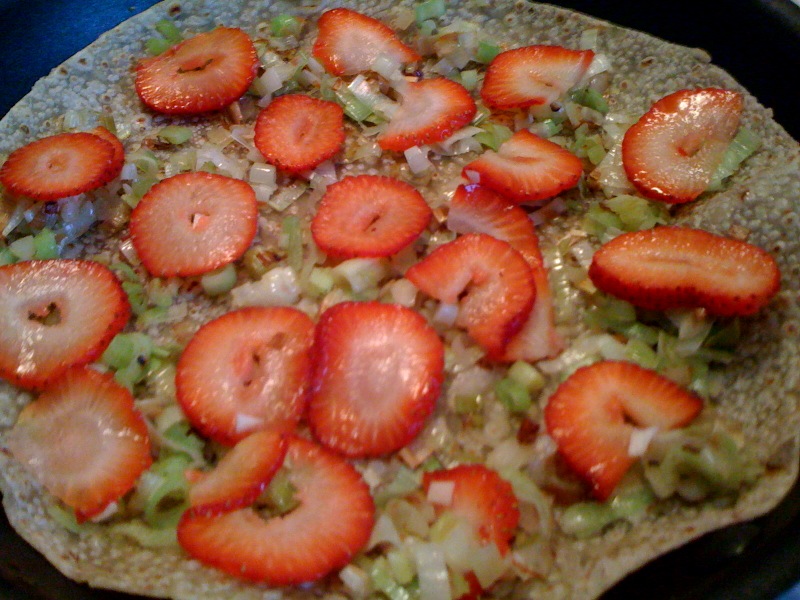
It's been a Sprouted Kitchen kind of week... humor me while I share another attempted recipe for her Strawberry + Leek Quesadillas. I made these on Sunday morning for brunch, and I felt pretty fancy pants when it was all said and done. Like maybe I should call a friend to come over so I could show off a little.

Thinly slice 1 leek and a handful of strawberries.

Saute the leeks in a tiny bit of olive oil until slightly brown, then remove and set aside.

Add a tiny drizzle of olive oil to the same pan and place 1 brown rice tortilla inside to start warming up.
Top with the leeks and strawberries.

Now, sprinkle mozzarella and goat cheese crumbles on top of the strawberry layer.

Place the second tortilla on top and press firmly to seal.
Flip it over and cook an additional few minutes to brown the other side.

Top with the remaining strawberries, a sprinkle of goat cheese and a few pieces of cilantro.
Your brunch-mate will thank you!


If you just can't get enough strawberries, give these recipes a try...


STRAWBERRY-AVOCADO SALSA:
http://www.myrecipes.com/recipe/strawberry-avocado-salsa-10000001891907/
Image courtesy of cookinglight.com


QUINOA SALAD WITH BLUEBERRIES, STRAWBERRIES & WATERMELON:
http://glutenfreegoddess.blogspot.com/2011/07/quinoa-salad-with-blueberries.html
Image courtesy of glutenfreegoddess.blogspot.com