Showing posts with label vitamin C. Show all posts

Wednesday, February 27, 2013

Snack Attack: 'Snip Chips!


If you live in New York, then there's a good chance you've contemplated moving to the Bahamas in the last few weeks. I know I have! It's been F-R-I-G-I-D here, and when it's not frigid, it's rainy. I mean, I'm wearing a thick hooded coat and carrying an umbrella, and I'm still wet and cold. For me, the only positive side of winter is the rosy glow it gives to my cheeks. Beyond the natural beauty assistance, I'm over it. 

When the weather's chilly and I'm looking to heat things up in the kitchen, I grab some root vegetables! Root vegetables are some of the best foods for warming up your body and feeling grounded during the long, cold winter season. My longtime favorite root vegetable used to be the sweet potato, but these days I have my sights set on the parsnip. 

Image via parsniprecipes.co.uk
Here's why you should snack on a 'snip...

LOW CAL - One cup of parsnips is just over 100 calories. It's a sweet snack without the excess baggage! 

FIBER - Parsnips contain both soluble and insoluble fiber, helping to lower your cholesterol, regulate your blood sugar and keep things moving! 

POTASSIUM - The potassium in parsnips works to maintain your tissues and organs, helps send nerve signals and also aids in the metabolizing of protein. 

VITAMIN C - Parsnips are a natural immune system booster! Plus, the vitamin C they contain helps your body absorb iron and aids in the formation of collagen.

FOLATE - Eating parsnips can help protect your unborn child from birth defects, while also lowering your blood homocysteine levels, helping to prevent disease.

See? It's a smart snack AND a snack you can make yourself!

Just in time for this post, I stumbled across the most glorious blog - Good Things Grow - and was inspired to try Jacqui's recipe for Parsnip Chips, which I've affectionately shortened to 'Snip Chips! Head on over to her blog for the full recipe, but if you'd like the quick rundown play-by-play style, here's my attempt!

Happy Snacking!

Heat the oven to 475 degrees. Grab as many parsnips as you want chips (3 small-medium sized parsnips yielded me a cereal size bowl of chips). Wash them and peel the outsides like you would a potato.
With a mandolin or a very sharp knife, slice your chips very thin. The thinner the better!
Now pat them dry with a paper towel to remove any excess perspiration.
In a pan, melt 2 Tbs. (or more if you're making a larger batch) of organic virgin coconut oil. We're using coconut oil because it has a much higher smoke point than olive oil. You can find it at Trader Joe's for about $6/jar.
In a large mixing bowl, drizzle the melted coconut oil over the chips and toss gently with your hands to spread evenly.
Now toast 1 tsp. of fennel seeds over medium-high heat (this should only take a couple of minutes)...
...then grind or crush the fennel seeds.
In the same bowl, add 1/2 tsp. each of ground cumin, chili powder, paprika and black pepper.
Mix the spices together and toss evenly onto the chips in the mixing bowl.
Now roast the chips on an ungreased baking sheet for 15-20 minutes, flipping the chips halfway in and at the same time, moving the pan from the top rack of the oven to the bottom rack. You have to watch them very carefully, as they burn easily!
Let them cool for a few minutes, then dive into your homemade, healthy snack!

Tuesday, December 18, 2012

Brothers From Another Mother: My Favorite Root Vegetables!

Image courtesy of saltandspatula.com
I don't know about you, but I can't walk two feet without running into a cookie... a cake... or a pie. It's that time of the year! Watch out pearly whites, Santa's got a sweet tooth and so do I! 

My mother has been making my favorite holiday cookie (Russian tea cakes) for as long as I can remember. Wait, hold on. I should actually give credit where credit is due, my mother's friend (and former college roommate) Carolyn is actually the one who's been making tea cakes for as long as I can remember.

...my mother just stole the recipe and claimed it as her own.

As lovely as tea cakes are, eating them for breakfast, lunch and dinner is clearly not the best move for optimal health (or desired waistline). Today I'd like to fill you in on a easy (and sneaky) way to curb that holiday sweet tooth... roasted root vegetables!

Now before I lose you to the cookie jar, hear me out. Roasted root vegetables give you that same feeling of satisfaction without leaving your body in crisis mode. When I'm craving something sinful, I just head to the organic produce section for some carrots and parsnips.

Carrots are rich in beta-carotene, which when converted into vitamin A, improves your vision, aids your skin in repair and slows down the aging process throughout your body. Carrots are also high in the carotenoids alpha-carotene and lutein, which have been shown to lower the risk of heart disease. Then to make matters even more spectacular, carrots produce a natural pesticide called falcarinol. Falcarinol protects the carrot's roots from fungal disease but has also been studied for its anti-cancer properties. Lastly, eating carrots stimulates your gums and triggers the production of saliva. The alkalinity of saliva works to counteract the destructive acidic bacteria that can cause cavities!

Image courtesy of jointhereboot.com
Parsnips are just as exciting! If you're not familiar with parsnips, they look like carrots but are usually larger and more creamy in color. They have a nutty sweet taste and contain a bit more potassium than their brother the carrot. Your body uses potassium to control your blood pressure and fight the negative effects of sodium intake on your body. Parsnips also contain more folate than carrots, which you will remember is needed to prevent birth defects in babies and to ensure healthy cell creation and cancer protection throughout life. In addition to potassium and folate, parsnips have both soluble and insoluble fiber, helping to reduce your blood cholesterol and keep your digestive track healthy! And if that wasn't enough already, parsnips are full of vitamin C, which helps you maintain healthy tissue, teeth and gums, while also scavenging your body for cancer-causing free radicals.

On top of all their nutritional benefits, carrots and parsnips are exceptionally delicious when roasted. The process of roasting allows their natural sugars to release, making them sweet as can be! Some people even propose that because they're grown underground, root vegetables can help you feel grounded when you're feeling scatterbrained, confused or 'all over the place'. I know when I eat them, they make me feel calm and peaceful (maybe because they remind me of my grandmother's kitchen and the comfort I felt there). 

Today, I'm sharing my former roommate Katie's recipe for roasted carrots and parsnips (see? I know how to give credit where credit is due). She's one hell of a cook, and this recipe is just too delicious not to share. Thanks, Katie!

Preheat the oven to 350 degrees and gather your ingredients (a bunch of fresh dill, 1 huge parsnip, a small bunch
of carrots, 1 lemon, olive oil, salt and pepper).
Wash and grate the outer, dirty layer off both the carrots and parsnip (especially if they're not organic!). Slice the
carrots in half lengthwise, then in half again, then cut into thirds (you want thin bite size slivers).
Do the same thing for the parsnip. Because it's larger, you'll have to make a few more cuts. You want both vegetable pieces to be similar in size so that they cook at the same rate.
In a large mixing bowl, lightly coat the mixture with extra virgin olive oil or your choice of oil (you'll need just enough
so that they don't burn, around 2 Tbs. or so).
Salt and pepper them to taste and mix well.
Lightly spray a cookie sheet with cooking spray (you won't need much) or line your cookie sheet with parchment paper.
Pour the vegetables over the tray and spread them out as best you can. Roast in the oven for 40-45 minutes total.
While your veggies are roasting, wash and finely chop a few sprigs of dill and cut your lemon open.
After about 20 minutes, flip the veggies and place back into the oven.
You'll know they're done when they start to brown and slightly crisp after about 40-45 minutes. They should have the
texture and consistency of a french fry.
Squeeze half a lemon over each cookie sheet (this recipe makes about 2 sheets worth) and sprinkle with fresh dill.
These roasted veggies make the perfect side dish, or like I said before, can easily substitute for dessert!


Monday, November 19, 2012

Spaghetti Squash: A Healthy Twist on a Classic Meal!

Image courtesy of justtosaywetried.tumblr.com
Who here loves spaghetti as much as I do? Spaghetti was ALWAYS my go-to dish in the elementary school cafeteria. When that savory smell started wafting through the halls of my school, I couldn't get to lunch fast enough. Who cared about taco day or sloppy joe day (or my white shirt, for that matter) when there was spaghetti to be eaten! My love for spaghetti didn't stop at school though, spaghetti was a staple in my family. My grandmother made it for us when we went to visit, my mom threw it together for a quick dinner and even my dad had a special spaghetti sauce recipe up his sleeve.

Shamefully, I never knew how to make spaghetti. My version of spaghetti involved a saute pan, a jar of Classico and a package of spaghetti noodles. Walah! Done in under 10 minutes! Now, while a jar of Classico or Prego isn't all that bad in the taste department, let's be honest! Homemade is just SO MUCH BETTER!

Image courtesy of steamykitchen.com
So today, I stole Adam's spaghetti recipe and added my own twist to make it healthier! Have you ever heard of spaghetti squash? This winter squash is pretty unusual. It's a close relative of the melon and the cucumber, but once you cook it, the flesh falls apart into strings of 'spaghetti'. Besides being so fun to make (kids will love scraping the inside and watching it transform into spaghetti), spaghetti squash is an excellent addition to your meal because it's full of...


OMEGA-3 AND OMEGA-6 FATTY ACIDS - I'm sure fish come to mind when you hear the term omega-3's, but fish are not the only way to get them! The omega-3's in spaghetti squash help prevent heart disease, cancer and arthritis inflammation, and the omega-6's found in squash promote brain function.

CAROTENOIDS - Carotenoids are the natural pigments found in plants - they make the tomatoes red and the squash yellow. Spaghetti squash, and other winter squash, are chock full of them. The beta-carotene and alpha-carotene found in spaghetti squash are converted by your body into the form of vitamin A that you need to maintain normal vision and glowing skin. They also act as antioxidants, helping your body prevent and fight inflammation. Now tell me, does your pasta do that?

FOLATE - I talk a lot about folate. The natural form found in food is EXTREMELY important in preventing birth defects and helping the body repair damage. Folate can play a major part in cancer prevention, and you need to make it an important component of your diet. Eating spaghetti squash is an easy way to do just that!

POTASSIUM - Bananas aren't the only good source of potassium! C'mon, you can be a little more creative than that! Spaghetti squash provides a solid contribution to your required daily value of potassium, which your body uses to keep your muscles and nerves functioning! 

VITAMIN C - Your body needs vitamin C to support a healthy immune system. Vitamin C scavenges your body for cancer-causing free radicals and helps to neutralize them. It also makes collagen, a type of skin tissue that aids in wound healing and repair.

So you see, you could make spaghetti the old-fashioned way OR you could increase your meal's nutritional content by substituting spaghetti squash. If you cook it correctly, the squash tastes fairly neutral and won't affect the taste of your favorite dish! Even Adam was pleasantly surprised! 

So here we go... healthy spaghetti with spaghetti squash!

First, preheat the oven to 350 degrees. Rinse the outside of the squash and pat it dry.
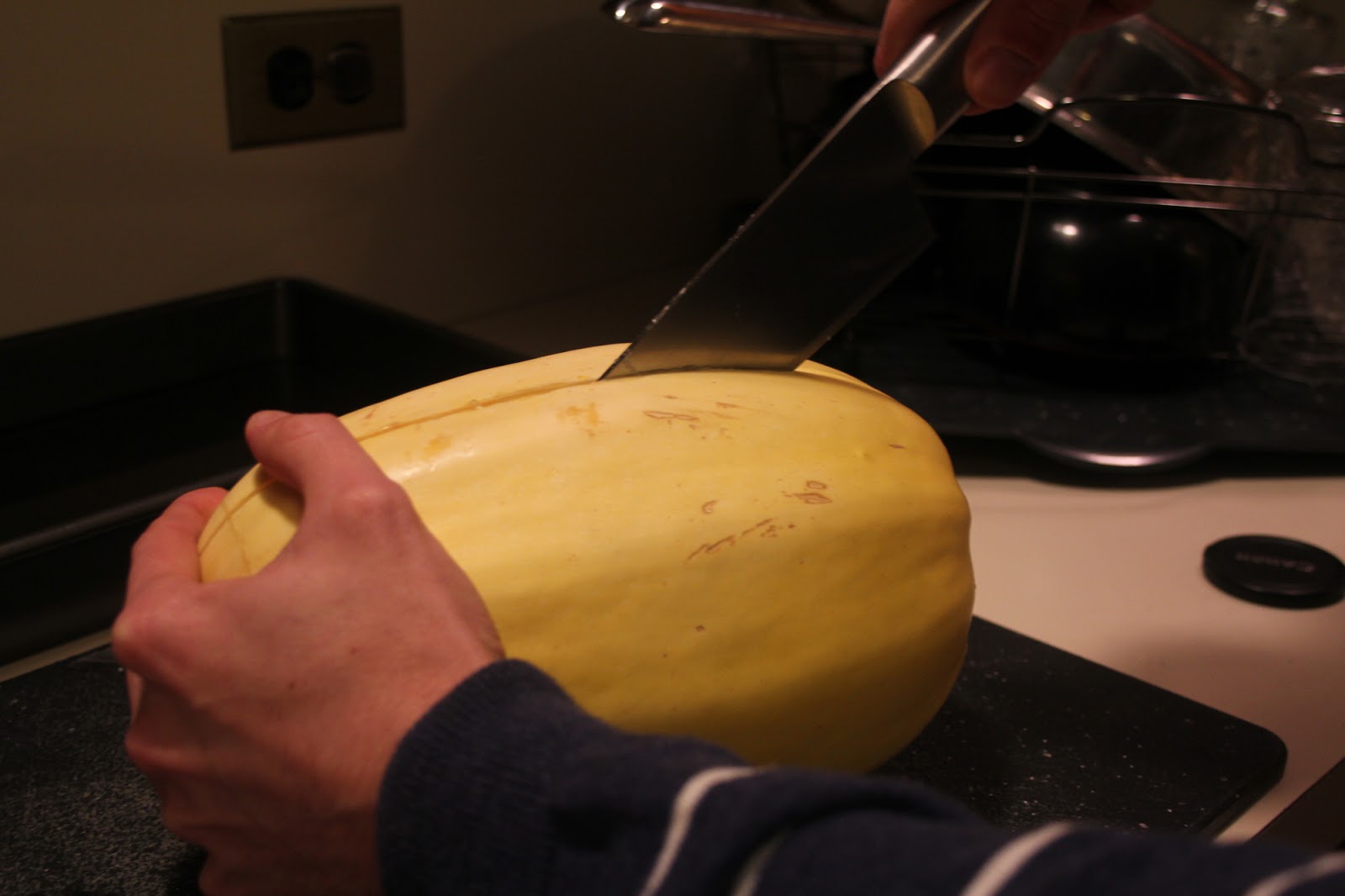
Then, if you're not a man, find one. Sometimes you need a little extra muscle to cut the squash in half length-wise.
Now get rid of the man (j/k) and scoop out the center.
You'll want that part to look clean and smooth when you're finished.
Fill a baking dish with 1/2 inch of water and lay the squash in (cut side down). Pop into the oven and set your alarm
for 45 minutes. Cooking can take anywhere from 45-60 minutes, so you'll want to check it along the way.
Meanwhile, on to the sauce...
I like to prep everything before I start cooking. NOTE: This recipe is for 1 batch of spaghetti (makes 3-4 servings).
You can easily double to have tomorrow's dinner ready and waiting! Finely chop 2-3 cloves of garlic.
Finely chop 1 medium-sized red onion.
Chop 1 package of white button tomatoes.
Chop 1 can of small black olives (or leave these out if you don't care for them). At this point, you can also
use a potato peeler to peel a few carrots. I use the potato peeler because it gives me see-through slices that I can't
create with just a knife.
In a saute pan over medium-high heat, add 1-2 Tbs. of extra virgin olive oil.
Throw in the garlic, red onion, and carrot slices (optional). Cook for 2-3 minutes.
Now, instead of using ground beef, we opt for lean ground turkey. I swear you won't notice the difference and
you'll be doing your body a favor.
Add the turkey to the garlic/onion mixture and cook all the way through (approx. 5 minutes - no pink left).
While it's cooking, spice it up a bit with a dash of pepper, garlic salt, dried basil or red pepper (whatever you like)!
Once it's cooked, if your pan is swimming in oil or fat, just dump a bit out (if you don't, the sauce will end up soupy).
Now add the mushrooms and cook for 2-3 minutes until they start to soften.
Throw in the olives, 1 can of diced tomatoes and 1 large can of crushed tomatoes.
Because I'm obsessed with spices, I add a bit more at this point. Make it your own!
Now I don't believe in sugar, but Adam does. It will make your spaghetti taste a little more sweet. Add 1 Tbs. at your own discretion (by no means is this a requirement). 
While the sauce is heating through, add 1-2 Tbs. of balsamic vinegar.
Once it's heated through, you're done! Look at that beautiful sauce! 
Now for the squash... it's done with you can pull it into strands with a fork and it still retains it's shape. We had a
humongous squash and it took exactly 1 hour. A small or medium squash will be closer to 45 minutes.
Have fun scraping the insides into spaghetti. I recommend putting the strands in a strainer
to remove excess water (just like you'd do for pasta). 
Then plate that healthy spaghetti up and enjoy! Think anyone will notice the difference?

Thursday, October 25, 2012

Swiss Chard: The Vegetable Valedictorian


It's blatantly obvious by now that I love the farmer's market. I love that the air is getting colder outside, but I'm beginning to dread the day when the farmer's market isn't bursting with color like normal. New York gets especially bleak in the winter - bare tree limbs, whipping winds, blustering snow storms - and shopping at the grocery store instead of the farmer's market just makes me want to cry! Why, Mother Nature? Why?

When we left the campsite last weekend in Beacon, we had just enough time to stop by the Sunday farmer's market on the Hudson River. We quickly scoped the wares and settled on a beautiful bunch of Swiss chard and two bunches of breakfast radishes (these babies are hard to find, so we got double!). 

You've probably seen Swiss chard many times. It's readily available in stores year-round. It has huge, dark green leaves and colorful stems that range from red or orange to yellow or white. It's truly a beautiful vegetable. Though it's name is deceiving, Swiss chard originated in Sicily. It has been a staple of the Mediterranean diet for thousands of years. It's a Chenopod (or herbaceous flowering plant), along with spinach, beets and quinoa. In fact, you cook it in a similar way to spinach and it has the earthy flavor of a beet, but I think it most closely compares to collard greens or kale in it's texture and flavor (but that could just be me and my crazy Southern influence).

Now to the most important part... why you should eat it! Swiss chard is...

Image courtesy of gonola.com
PACKED WITH VITAMIN K - In fact, 1 cup of cooked chard has approximately 700% of your daily value. Vitamin K keeps your bones strong, and supports proper functioning of the brain and nervous system.

CHOCK FULL OF ANTIOXIDANTS - Swiss chard is one of the most antioxidant-rich foods on the PLANET! It's vivid colors should tell you that! Chard contains 13 different polyphenol antioxidants which help you fight disease!

FULL OF FIBER - The fiber in chard (especially in the colorful stems) helps reduce your cholesterol, keeps your digestive system happy and allows your body to maintain normal blood sugar levels. One cup of cooked chard contains approximately 14% of your DV.

BURSTING WITH VITAMINS A & C - One cup of cooked chard contains 214% of your DV of vitamin A (for healthy vision, skin, teeth and mucous membranes) and almost 50% of your DV of vitamin C (for a strong immune system, normal connective tissue and healthy iron levels).

LADEN WITH LUTEIN - Lutein is essential for eye health. Research suggest that you get between 6,000 and 10,000 mcg of lutein per day. Looks like it's your lucky day then! That same 1 cup of cooked chard contains approximately 9, 276 mcg. Done and done!

BRIMFUL OF BIOTIN - You need this vitamin for hair growth and strength. One cup of cooked chard contains 1/3 of your DV. Healthy locks, here we come!

Ok, now that you know how good it is for you, what the hell should you do with it? That part is easy! Boiling is the most recommended method for cooking chard because it allows the oxalates in the chard to escape. Oxalates can hinder the body's ability to absorb calcium and are good to avoid if you suffer from kidney stones.

In addition to boiling, I also like to saute it, which is pretty easy when you're in a hurry. Here's a photo play-by-play of the chard we cooked this week...

Chop off the stems of the chard... If some of your leaves have larger veins running up the middle, you can cut those
off as well. The stems are edible, but because they take longer to cook and I was in a hurry, I chose not to.
Wash the leaves in a bowl of cold water - this should be done a few times to ensure that they are clean.
Pat the leaves dry and slice into 1 inch strips.
Finely dice 3-4 cloves of garlic. The more the merrier in my book (unless you have a date later, then this
would be a horrible idea)!
In a large saute pan, saute the garlic in a few tablespoons of extra virgin olive oil. I LATER learned that you
shouldn't use an aluminum pan because of the reaction the oxalates will cause. It will destroy your pan.
Don't say I didn't warn you.
Once the garlic has cooked for 2-3 minutes, add the Swiss chard and saute until wilted.
Getting close....
Almost there...
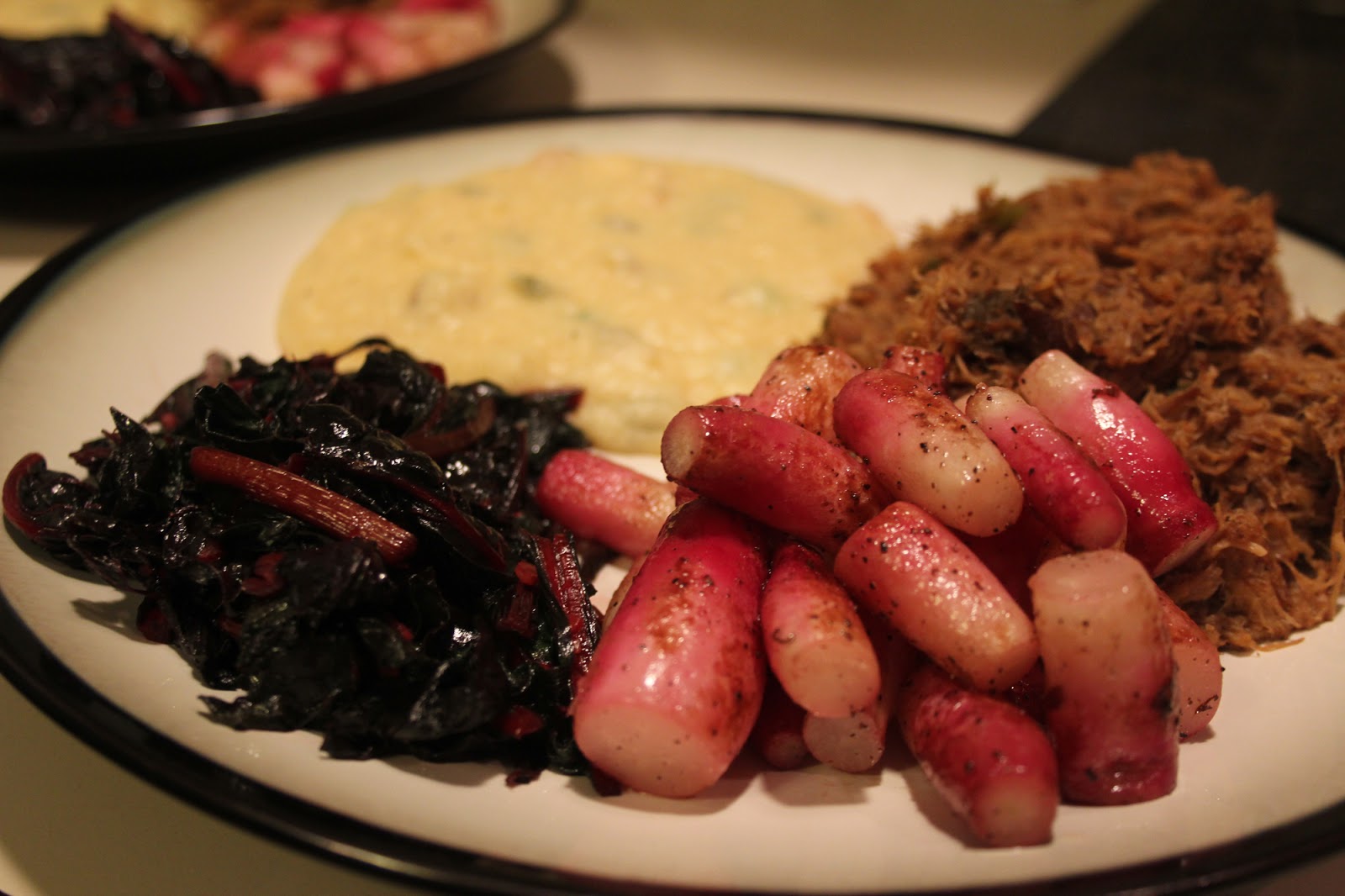
And that's how you do dinner on the fly! Reheat homemade free-range pulled pork and potatoes, saute breakfast
radishes and Swiss chard! Ta da! (P.S. Breakfast radishes are my jam and will be covered next week!)

Swiss chard is great because it goes with just about anything! You can throw it into your eggs, include it in a stirfry or pasta dish, make it into a tasty stand-alone side dish or even juice it! Now hopefully you have more time than me when you are cooking your beautiful batch of chard. If so, you should try these recipes that I was drooling over and then report back...


LEEK, CHARD AND CORN FLATBREAD


SWISS CHARD, CHIVE & GOAT CHEESE PASTA